

How Cloud native development is Revolutionizing Software Development in 2025?
Oct. 8, 2025
899

Table of Contents
When was the last time you waited weeks for your IT team to update a simple feature update? If you're nodding your head right now, you're not alone.
The software development industry is experiencing a seismic shift. Organizations are ditching their legacy systems in favor of cloud-native solutions. This is actually transforming how we build and maintain software. I would say that this isn't just a trend, it's a full-blown revolution.
Let us have a look at a mind-blowing stat: According to Gartner, global spending on public cloud services hit $679 billion in 2024, with expectations to cruise past $1 trillion by 2027. That's right, trillion with a T. This massive investment shows a clear message: the future of software development lives in the cloud.
So, are you ready to join the revolution of the cloud native development? Let's dig deeper into it…
Hidden Costs of Outdated Systems
Picture this: You're trying to race a Formula 1 car, but you're stuck driving your grandpa's 1985 station wagon. That's essentially what running legacy systems feels like in today's digital world.
Legacy systems, those aging software applications and infrastructure that organizations have clung to for decades are becoming more liability than asset. Think they're just "old but reliable"? Think again.
Would you leave your front door unlocked in a high-crime neighborhood? That's essentially what older systems do. They lack modern security protocols, making them candy stores for cybercriminals.
Remember dial-up internet? Legacy systems are the dial-up of modern computing. They were designed for predictable workloads from a simpler era.
Today, when your app could go viral overnight, these systems freeze up faster than a laptop with 50 browser tabs open. The inability to scale rapidly costs businesses an estimated $26 billion annually in lost revenue.
Innovation Bottleneck
Here's the brutal truth: Your talented developers aren't building the next game-changing feature. Instead, they're playing Tetris with system limitations and duct-taping workarounds together.
According to McKinsey, organizations with modernized systems deploy new features 200 times more frequently than those shackled to legacy infrastructure. Let that sink in 200 times. While your competition ships updates weekly, you're still waiting for quarterly releases.
Advantages of Cloud Native Development
Ready for some good news? The cloud isn't just better, it's transformational. Let's break down why everyone's making the switch.
Infrastructure as Code (IaC)
Imagine if you could snap your fingers and poof—your entire infrastructure appears, perfectly configured. That's basically what Infrastructure as Code does (minus the magic dust).
Cloud platforms let developers manage infrastructure through code instead of clicking through endless configuration screens. Remember when deploying new infrastructure took weeks of meetings, approvals, and manual setup? Those days are over.
Microservices Architecture
Pop quiz: Would you rather maintain one massive, tangled ball of code or a collection of small, independent services that don't bring down your entire system when one piece breaks?
The cloud enables microservices architecture, breaking monolithic applications into bite-sized, manageable chunks. Netflix (yes, that Netflix) deploys code thousands of times per day across its microservices infrastructure. Try doing that with a traditional monolith, we'll wait.
Forrester research shows that organizations adopting microservices see a 60% reduction in time-to-market for new features and a 50% decrease in those heart-attack-inducing critical production incidents.
Read more about Microsoft Azure vs. Google Cloud Platform: The Ultimate Cloud Platform Comparison
DevOps and CI/CD
Here's where it gets really exciting. Cloud platforms come with native support for DevOps practices and CI/CD pipelines built right in. This means you can automate testing, deployment, and monitoring from start to finish.
The numbers don't lie:
- 46 times faster recovery from incidents (from hours to minutes)
- 7 times fewer deployment failures (fewer weekend emergency calls)
- 2,555 times faster from code commit to deployment (yes, you read that correctly)
These aren't theoretical "in a perfect world" numbers, they're from the State of DevOps Report, analyzing thousands of real organizations worldwide. What could your team accomplish with these kinds of improvements?
Here's the thing nobody tells you: The hardest part of cloud migration isn't the technology, it's the people.
Successful cloud migration requires more than just moving servers around. It demands a fundamental shift in how your organization thinks and operates. We're talking about moving from rigid, "that's not my department" silos to collaborative, "let's figure this out together" agile teams.
The Skills Gap Challenge
There's a massive shortage of cloud talent out there. The Linux Foundation reports a 60% global shortage in cloud computing professionals. Translation? If you're waiting to hire a fully-formed cloud expert, you might be waiting a while. IT modernization challenges for organizations are often centered more on human capital development than on the technological complexity, cultural transformation, or legal barriers.
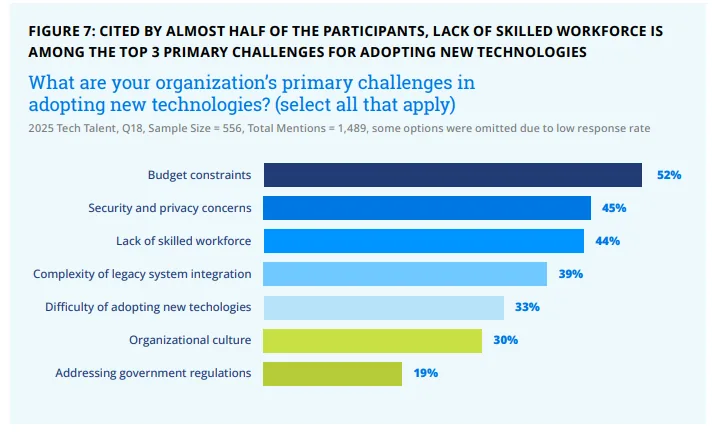
But here's the good news: Organizations that invest in upskilling their existing teams report 40% faster cloud adoption rates and 30% lower migration costs. Your current developers already know your business inside and out.
Success Stories
Okay, enough theory, let's talk about real companies crushing it with cloud migration.
Picture this Black Friday scenario: A mid-sized e-commerce platform suddenly gets slammed with 40 times their normal daily traffic. Their servers should be smoking and their site should be down, right?
Wrong. After moving to cloud-native architecture, they handled the surge without breaking a sweat—zero downtime, zero performance hiccups. Previously, Black Friday meant months of prep work, crossed fingers, and still frequent crashes. Now? They scale automatically and sleep peacefully through the shopping frenzy.
Healthcare Innovation
A healthcare tech company used cloud services to roll out AI-powered diagnostic tools across 200 hospitals in just 6 months. With their old legacy infrastructure, this rollout would have taken years and cost millions more.
The impact? Faster diagnoses, better patient outcomes, and doctors with powerful tools at their fingertips—all delivered in record time.
Best Practices
So you're sold on the cloud, awesome! But how do you actually get there without creating chaos? Let's break it down into bite-sized, manageable pieces.
Assessment and Planning
Start by taking inventory of what you've got. Think of it like preparing to move houses—you need to know what you're packing before you start throwing stuff in boxes.
The "6 Rs" framework is your best friend here:
- Rehost: The "lift and shift" approach—move it as-is (quick and dirty, but gets you started)
- Replatform: Make some tweaks during the move (optimize as you go)
- Refactor: Complete makeover for cloud-native architecture (the gold standard, but takes time)
- Repurchase: Ditch your old app and switch to a SaaS alternative (sometimes it's just easier)
- Retire: Kill off that application nobody actually uses anymore (you know the one)
- Retain: Keep it on-premises for now (some things can wait)
Pro tip: Start with the applications that'll give you the biggest bang for your buck and are technically easiest to move
Security-First Approach
Listen up, this is critical: Security cannot be something you bolt on at the end. Bake it in from day one.
Organizations that prioritize security during migration experience 73% fewer security incidents post-migration. That's the difference between sleeping soundly and getting emergency calls at 3 AM about a breach.
Incremental Migration
Here's a mistake we see all the time: Companies trying to move everything at once in one massive "big bang" migration. The success rate? A dismal 47%.
Compare that to incremental, phased migrations with a 92% success rate. Start with a non-critical application, learn the ropes, build confidence, then scale up. It's like learning to swim, you start in the shallow end, not by diving into the deep end.
Monitor and Optimize
Once you're in the cloud, the work isn't over. Think of it like buying a house, the real work begins after you move in.
The good news? Cloud platforms give you incredible observability tools. Organizations actively using these tools reduce their cloud costs by 30% on average while boosting performance by 25%. That's literally getting more for less.
Conclusion
So here we are, decision time.
The migration from legacy systems to cloud native development is way more than just a tech upgrade. It's a complete reimagining of how your organization creates value through software. Companies embracing this transformation aren't just keeping up—they're lapping their competition.
The stats speak for themselves: cloud-native organizations innovate faster, scale more efficiently, and pivot on a dime when the market shifts. But beyond all those impressive numbers, there's something even more important—empowering your developers to actually solve problems instead of wrestling with infrastructure headaches.
The real question isn't whether to migrate to the cloud. That ship has sailed. The question is: how quickly can you execute your transformation while keeping risks in check?
The winners will be the organizations that see cloud adoption not as "just another IT project," but as a strategic business game-changer that touches every part of the company.
The revolution is here. The cloud is waiting. Your competitors are already moving.
What are you waiting for?
Frequently Asked Questions (FAQs)
How long does a typical cloud migration take?
The timeline varies significantly based on your infrastructure complexity and scope. Small to medium applications can migrate in 3-6 months, while enterprise-wide transformations typically take 18-36 months.
What's the real cost of migrating to the cloud?
Migration costs typically range from 15-30% of your annual IT budget, but the ROI is substantial.
Will we need to hire new staff or can we retrain existing teams?
Both approaches work, but upskilling existing staff is often more effective and cost-efficient. Your current team already understands your business logic and systems.